
The avocado paradox
At AdD Global, we regularly guide brands through the complexities of opening new foreign markets and this fascinating case study is something important to learn from as it is about a premium Spanish avocado and guacamole brand attempting to conquer the Japanese retail market.
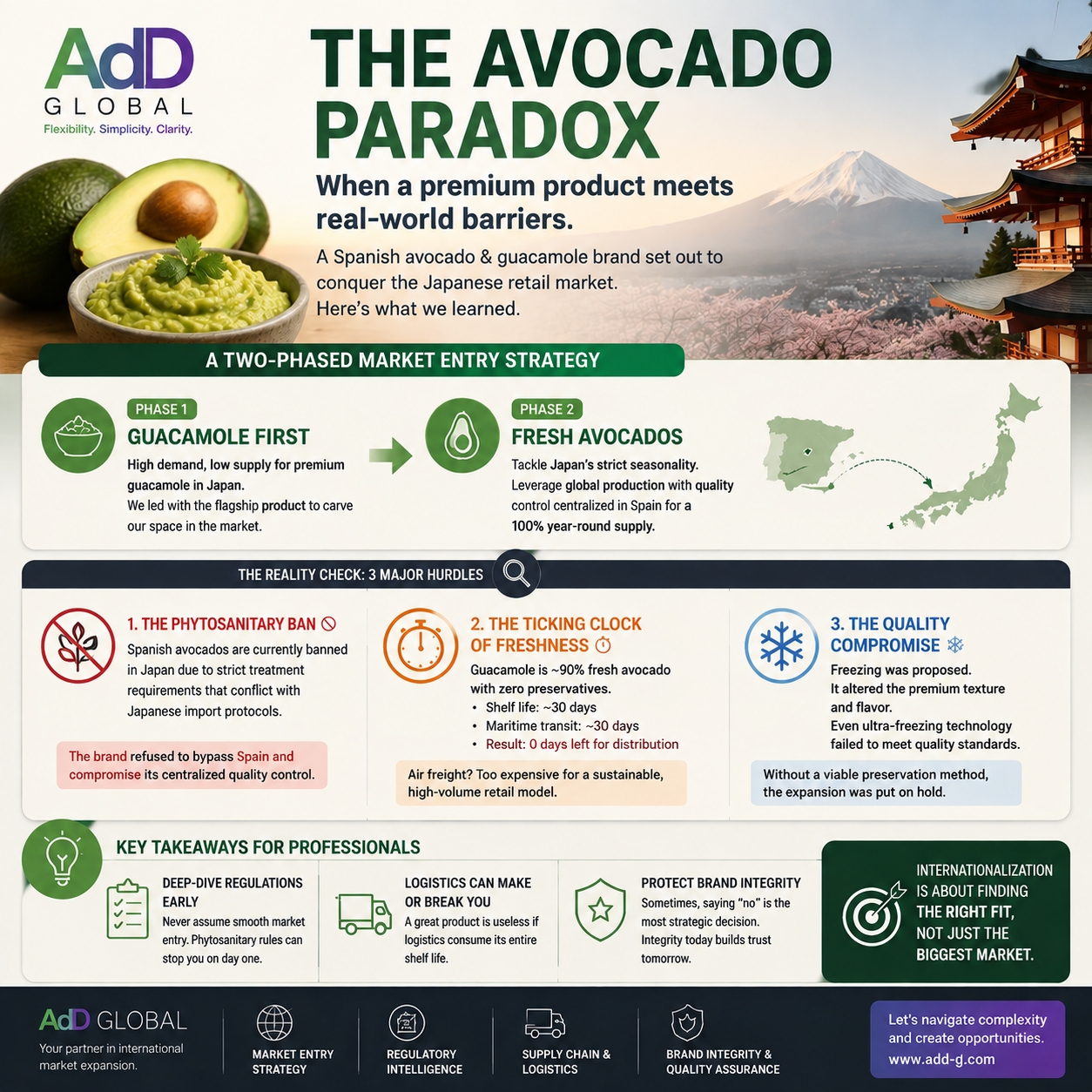
A Two-Phased Market Entry
We partnered with a team of local Japanese experts who specialize in food and beverage market entry. Our prospect was a top-tier Spanish brand with a phenomenal product. Together, we designed a solid, two-phased strategy:
Phase 1: Guacamole First.
Market research indicated a high demand and low supply for premium guacamole in the Japanese retail sector. We decided to lead with the brand’s flagship product to carve out our space in the market.
Phase 2: Fresh Avocados.
Avocados in Japan are subject to strict seasonality. To solve this, the plan was to leverage the brand’s global production network, while keeping the quality control centralized in Spain, to provide a continuous, 100% year-round supply of fresh avocados.
The Reality Check:
In international business, theory rarely survives contact with reality without a few bruises. Here is where our strategic plan met three major hurdles.
Hurdle 1: The Phytosanitary Ban 🚫
During our deep dive into the market, we hit a significant regulatory wall: Spanish avocados are currently banned from entering Japan. The core issue lies in the strict treatment requirements for long-distance transport, which clash directly with Japanese import protocols.
While the brand had farms globally and could technically ship from outside of Spain, their operational model dictates that all products must be processed and quality-checked in Spain to maintain their premium status. Bypassing Spain meant bypassing their quality control. The brand rightfully refused to compromise on this.
Hurdle 2: The Ticking Clock of Freshness ⏱️
With fresh avocados off the table, we pivoted entirely to Phase 1: the guacamole. This isn’t your average supermarket dip; it is a pure, >90% fresh avocado product with absolutely zero artificial preservatives.
The catch? A shelf life of roughly 30 days.
Maritime transport from Spain to Japan takes nearly that entire duration. By the time the product would clear customs, there would be zero days left for retail distribution.
Air freight was heavily evaluated. While it solves the time constraint, the costs are financially prohibitive for a stable, high-volume retail supply chain. It works for initial market sampling, but it is not a sustainable long-term business model.
Hurdle 3: The Quality Compromise ❄️
Seeking a solution, our Japanese partners suggested freezing the guacamole for the ocean voyage. The brand’s quality department immediately flagged this: freezing fundamentally altered the product’s premium texture and flavor profile.
Not willing to give up, we tested cutting-edge ultra-freezing technology in the lab. After rigorous testing, the verdict remained the same. It simply did not meet their strict quality standards. Without a viable preservation method, the expansion project had to be put on hold.
The Takeaway for Professionals 💡
What can we learn from this AdD Global business case?
Regulatory Deep-Dives are Non-Negotiable: Never assume your product can cross borders smoothly just because it is successful at home. Phytosanitary regulations and specific treatment requirements can halt a project on day one.
Logistical Viability: A superior product is useless if the logistics consume its entire shelf life. Always calculate transit times against product viability, especially for fresh, preservative-free goods.
Protecting Brand Integrity: Sometimes, the most strategic and successful decision you can make is saying «no.» The brand chose not to dilute its quality or change its centralized control just to force an entry into a new market. That level of integrity is worth far more in the long run.
Internationalization is about finding the right fit, not just the biggest market.
Pablo Gallardo
September 2026