
How to grow in the European market
Have you ever thought about how complex and fascinating the European market really is? We are talking about nearly 450 million people, 27 countries with completely different cultures and interests, and a history deeply marked by fragmentation.
Looking back, Europe’s geography always favoured the emergence of multiple, independent centres of power. For centuries, the continent operated as a permanent machine of territorial and religious conflicts, culminating in the absolute catastrophe of the two World Wars. However, a revolutionary idea was born out of from this destruction: making war impossible through economic interdependence. What started with the ECSC (European Coal and Steel Community) and the Treaties of Rome evolved in 1992 with the Maastricht Treaty, giving birth to the Euro and transforming a massive economic club into an unprecedented political and commercial project.
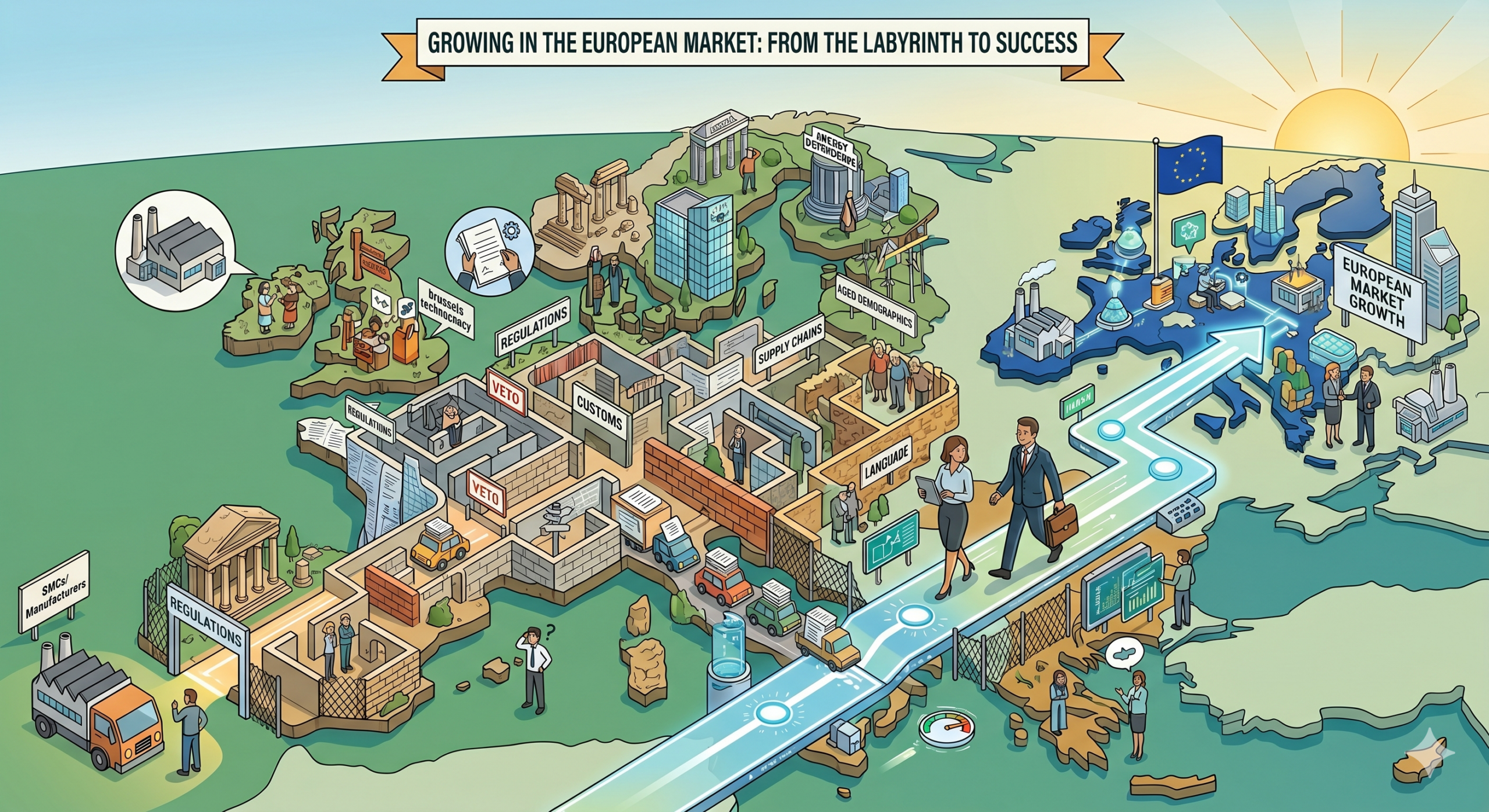
Today, Europe is an economic superpower, but navigating it means facing a monumental bureaucratic puzzle. The institutions in Brussels often concentrate enormous technocratic power, and therefore decision-making among 27 sovereign nations is usually super slow and full of cross-vetoes. Add to this some critical modern challenges: high energy dependence, losing ground in technological innovation to the USA, China’s dominance of supply chains, and an ageing demographic that is heavily pressuring the labour markets.
History has taught us that major crises transform the structures of the continent. Back in 1347, the Black Death tragedy devastated the population, but paradoxically, this was also the beginning of the end of the feudal system, made labour more valuable, and paved the way for the Renaissance and the modern world. In the same way, today’s geopolitical challenges are forcing companies to completely change how they operate.
The real problem for companies looking to expand into the European Union isn’t geographical borders; it is the labyrinth of complexity. Most SMEs treat internationalisation as a maze. In their attempt to adapt to the regulations of different countries, they make the mistake of adding layers upon layers of internal bureaucracy, falling straight into operational chaos and paralysis.
The truth is quite simple: to successfully grow and scale in such a highly regulated and diverse environment, the solution is an executing partner. An expert ally that takes care of removing operational friction, automating heavy processes, and implementing practical, tech-driven systems that allow you to act with speed and precision.
In a market saturated with rules, the ability to simplify and execute with confidence is what makes the difference.
Jose Martinez
June 2026