
How Japan’s landscape shapes its market
Your surroundings dictate indeed your future. While geography doesn’t completely decide a nation’s destiny, it absolutely sets the boundaries within which that nation can move and grow.
Today, I want to share with you a fascinating case: Japan.
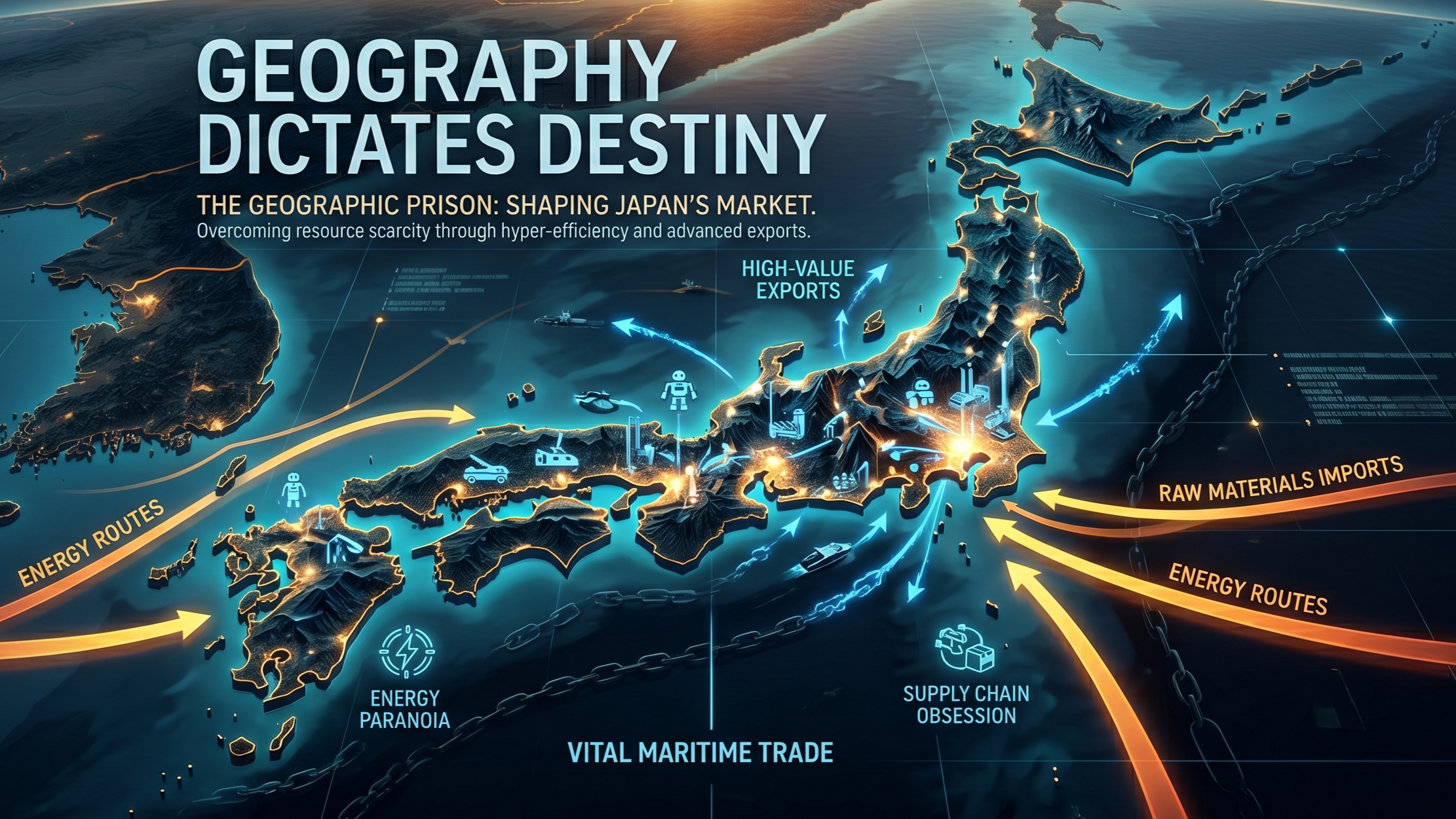
When we think of the Japanese market, we immediately think of an enormous industrial power. But there is a massive catch. Japan practically has zero oil, gas, or sufficient raw materials of its own to feed its massive economy.
Because it is an archipelago, the country is entirely dependent on maritime trade. Its survival relies on ensuring that its energy routes remain open and secure.
This creates what it could be called an «energy paranoia». This geographic vulnerability explains a lot about the country:
* It clarifies their historical decisions, such as their imperial expansion before the Second World War.
* It explains their current, deep-seated geopolitical concerns regarding the East China Sea and the security of Taiwan.
This geographic «prison» has forced the Japanese market to develop incredibly specific characteristics:
* Hyper-Efficiency: Without natural resources, Japanese companies cannot afford to waste materials. This geographic limitation birthed world-renowned manufacturing philosophies (like Lean and Just-in-Time).
* High-Value Exports: Since they must import almost all their raw materials, they survive by adding immense value to them. They import basic metals and export highly advanced robotics, vehicles, and electronics.
* Supply Chain Obsession: For a Japanese company, a broken supply chain isn’t just an inconvenience; it’s a critical threat. Their entire corporate culture is built around reliability and long-term planning to mitigate the risks of being an isolated island nation.
Japan’s geography could have been the ultimate stopper. But they didn’t let it be. They took their biggest weakness and built a market culture around overcoming it.
Jose Martinez
June 2026