
The geographical borders of the European market
We spend our days talking about economics, politics, and talent, but we rarely look at the silent board where this game is played: our geography.
Geography might not dictate our future completely, but it certainly sets the boundaries the markets have to navigate. Let’s take a look at our old continent, Europe, and see how mountains, rivers, and seas have shaped our markets.
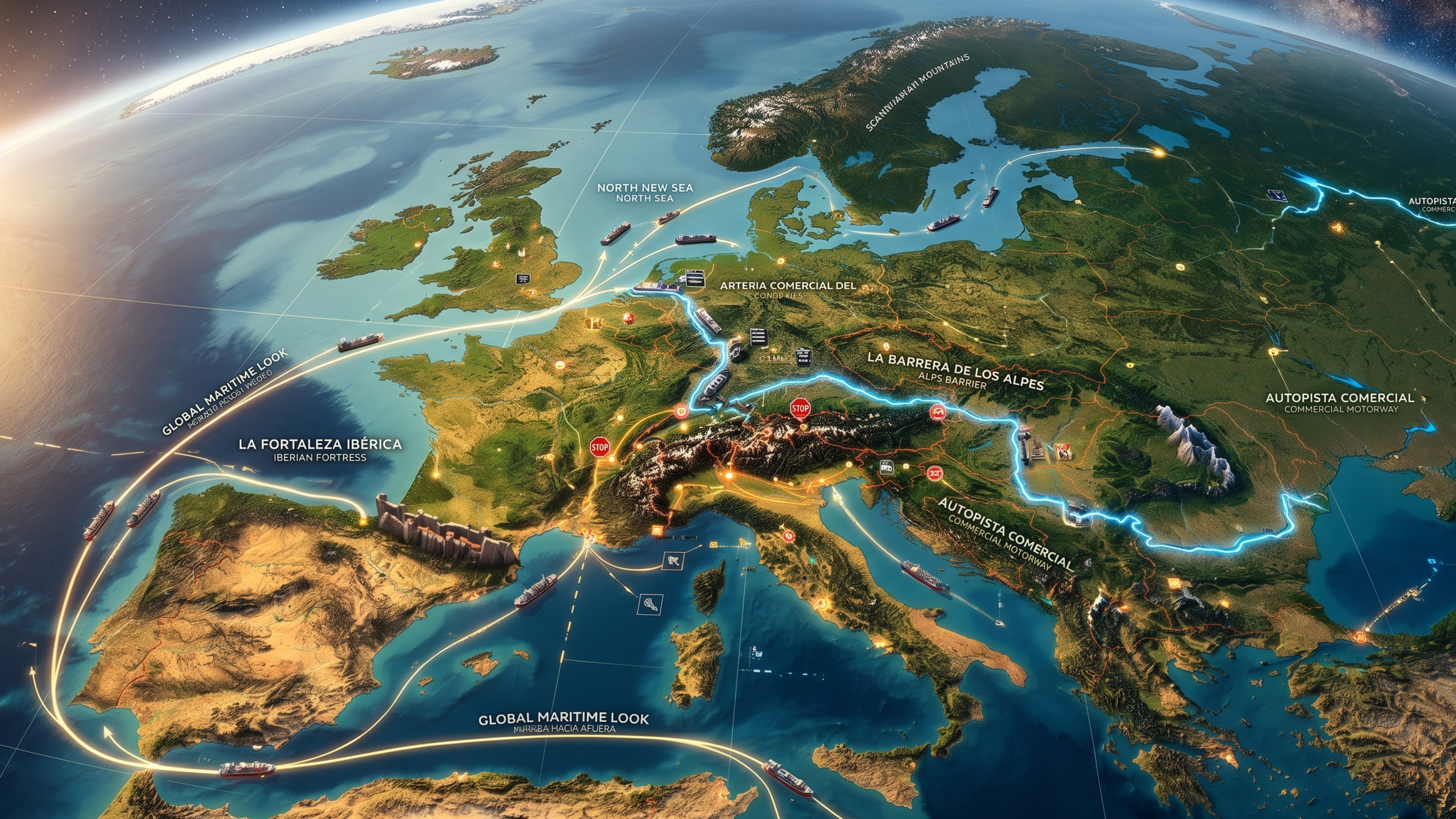
Before trains or planes, rivers were the great motorways of the planet. They allowed goods to move cheaply, fed crops, and connected cities. Look at the Rhine, for example. It connects Switzerland, Germany, France, and the Netherlands to the North Sea. For centuries, it was a fundamental commercial artery that allowed Central Europe to industrialise, moving coal and steel at a low cost. Even today, any issue with the Rhine’s water levels directly affects the European economy.
The same goes for the Volga, the longest river in Europe, which acted as a historical artery to integrate massive territories and consolidate trade across Eurasia long before the arrival of the railway.
Mountains are probably the most powerful defensive tools in history. They isolate cultures, slow down invasions, and force history down very specific paths. The Alps, for instance, marked a natural border between northern and southern Europe for centuries, creating very different economic, political, and cultural dynamics on either side.
If you look at the map, the Iberian Peninsula is almost a fortress. The Pyrenees form a massive wall connecting us to France, which historically acted as a geographical bottleneck for land trade with the rest of Europe. Furthermore, Spain is one of the most mountainous countries in Europe. This rugged internal geography meant that, for centuries, connecting the different Spanish regions was technically complex and highly expensive. This geographical «prison» fragmented our internal market and forced us to look outward, to the sea, eventually driving us to become a global maritime power.
Now, imagine another mountainous fortress: Albania. Tucked away in the Balkans, Albania is dominated by incredibly harsh terrain, including the Accursed Mountains and the Dinaric Alps. For a long time, this landscape made it extremely difficult to build infrastructure or integrate its internal market with its neighbours. The mountains acted as a shield, but they also severely limited their international trade and economic expansion. Only now, with modern engineering and a determination to open up, is Albania truly unlocking its market potential.
It is impressive how much a country’s economy can improve, by setting the right priorities at the right time. Geography gives us the rules of the game, but it is up to us, as a society, to decide how we play it.
Jose Martinez
June 2026