
How geography shapes the markets of the Americas
We often blame politicians, historical events, or economic policies. But what if the real boss is actually the ground we walk on? Geography does not completely decide the destiny of a nation, but it certainly sets the boundaries within which that nation can operate.
Today, I want to take you on a journey across the Americas to see how mountains, rivers, and coastlines have completely conditioned their markets. Let’s dive in!
The North:
First things first, let’s talk about the United States and its ultimate natural advantage: the Mississippi River.
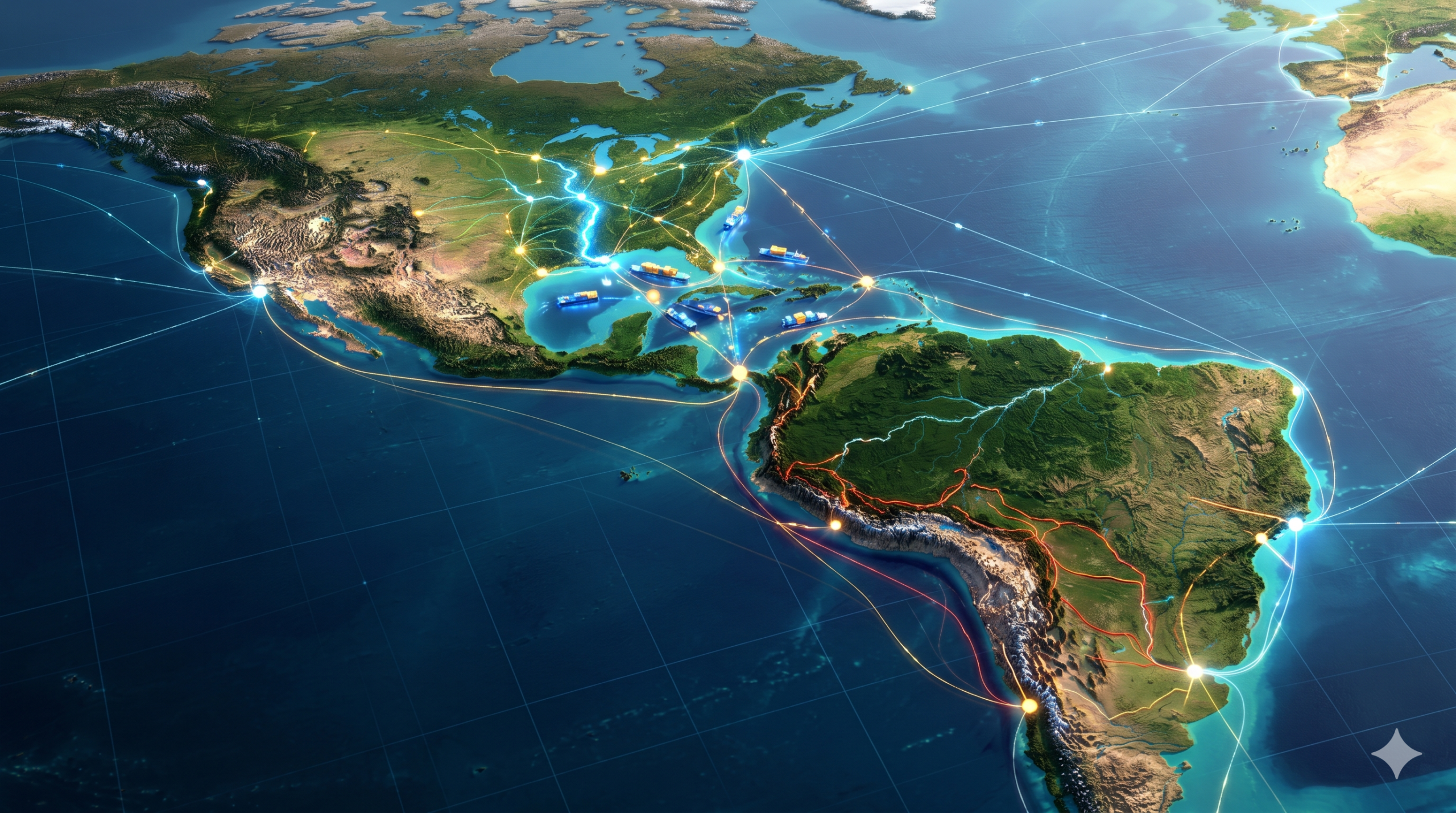
Before railways, aeroplanes, or motorways existed, rivers were the great highways of the planet. The Mississippi-Missouri river system is not just a body of water; it is a massive, natural transport network that connects the agricultural and industrial heartland of the US directly to the Gulf of Mexico.
Whilst other nations had to invest billions in building infrastructure, the USA already possessed a gigantic, ready-to-use network to move goods cheaply across the continent. Many analysts consider this fluvial network to be one of the hidden reasons for the American economic rise.
The South:
Now, let’s travel further south. The landscape changes completely, and so do the rules of the game.
Have you ever considered the sheer scale of the Andes? They are probably the most powerful defensive tool in history, but economically, they are a massive wall. The Andes traverse practically the entire South American continent from north to south, severely hindering connections between regions.
For centuries, major South American cities were better connected to Europe by sea than to each other by land! This historical isolation helped create separate economies, cultures, and identities. Even today, building infrastructure across the Andes remains incredibly expensive and technically complex.
Furthermore, South America is home to the Amazon, a river that moves more water than any other on Earth. However, the surrounding rainforest acts as a natural barrier, keeping massive zones practically isolated and making it a monumental challenge for governments to fully control or economically integrate these territories.
We cannot talk about markets without talking about the sea. Controlling maritime routes is an absolute necessity for international trade.
Take Bolivia, for example. They lost their access to the Pacific Ocean to Chile in the 19th-century War of the Pacific. What does this mean for their market today?
➡️ It significantly increases the cost of exports.
➡️ It generates a massive logistical dependency on neighbouring countries.
➡️ It severely limits their international trade potential.
What is the takeaway?
All in all, the geography of the Americas teaches us a vital lesson. Whether it is the commercial blessing of the Mississippi or the isolating wall of the Andes, our physical world shapes our economic reality.
However, geography might set the limits, but human ingenuity, collaboration, and strategic decision-making are what truly drive a market forward.
Jose Martinez
June 2026