
The tariff myth: why the media is wrong and why exporters don’t pay the bill
If you follow the 24-hour news cycle, the narrative around international trade sounds like a cautionary tale for Small and Medium-Sized Businesses (SMBs). Headlines scream about «slapped tariffs» and «trade wars», causing many brilliant manufacturers to freeze their expansion plans.
The immediate (and logical) reaction is: “Why would I export if I’m going to be hit with a massive tax bill at the border?”
At AdD Global, we see world-class businesses hit the brakes because of this exact misconception. It’s time to cut through the geopolitical noise, demystify the mechanics of global trade, and replace fear-based reactions with a calculated international strategy.
The Big Myth: «The Exporter Pays the Tax»
When «Country A» imposes a 20% tariff on goods from «Country B,» the media often frames it as «Country A taxing Country B.» This implies that the manufacturer in Country B has to write a check to a foreign government.
This is fundamentally false.
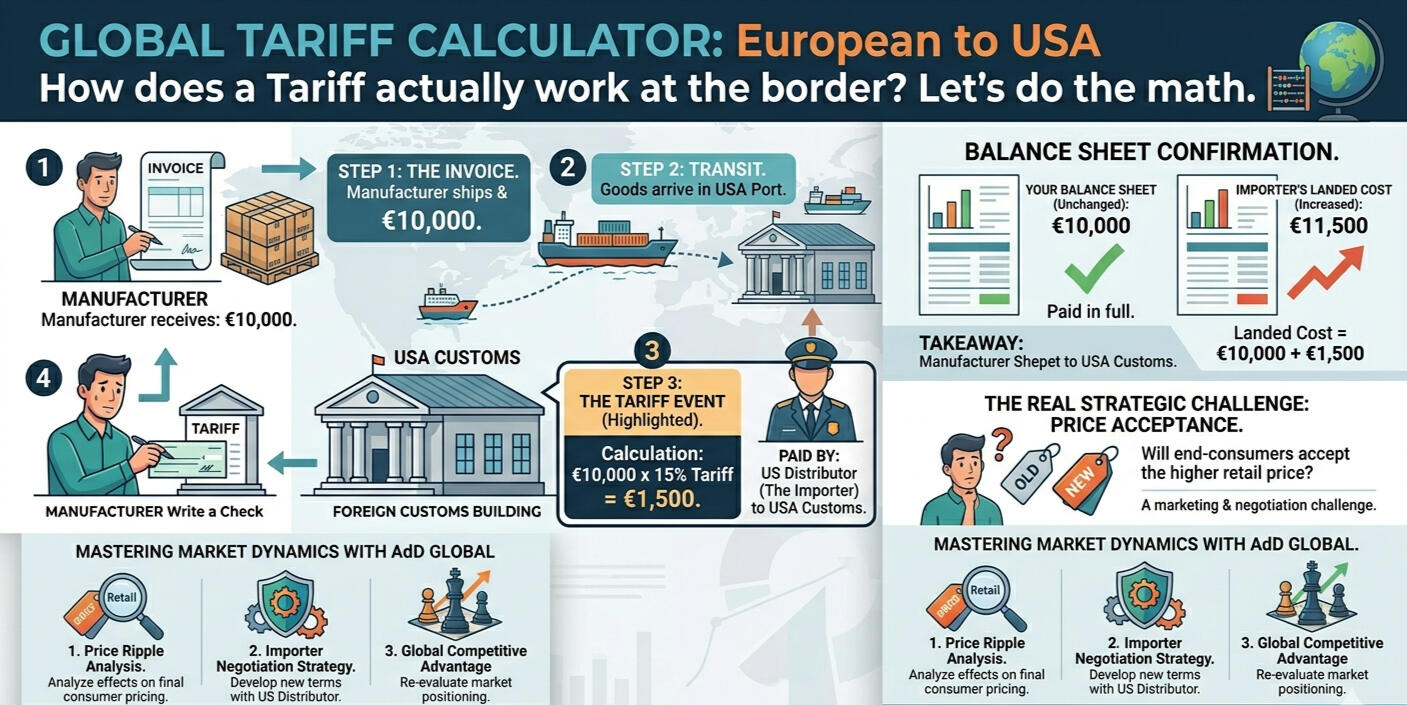
A tariff is a domestic tax imposed on imported goods. It is a financial obligation paid by the Importer (the buyer) to their own government at their own customs border.
If you are a European manufacturer shipping to a distributor in the United States, and the US imposes a tariff, you do not pay the US government. Your American partner pays the US Customs and Border Protection when the container arrives. Your invoice remains exactly the same.
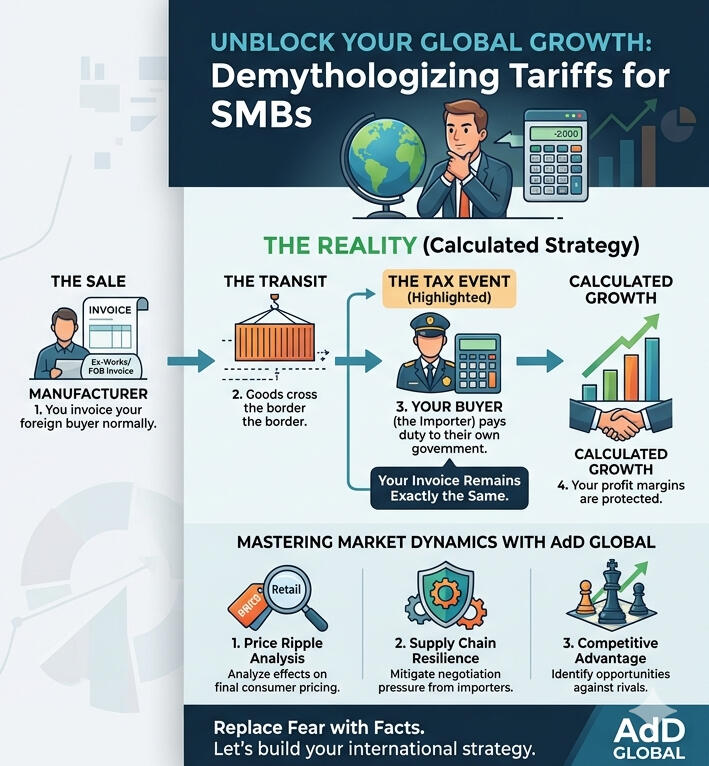
To understand why your balance sheet remains untouched by the tax man, let’s look at the operational flow of a standard export deal:
➡️ The Sale: You sell a pallet of goods to a foreign buyer (utilizing Incoterms like Ex-Works or FOB).
➡️ The Transit: The goods cross the border.
➡️ The Tax Event: To clear customs, the Foreign Buyer must pay their government the duty based on the Customs Valuation of your invoice.
➡️ The Bank Account: You have already been paid (o are owed) your full invoice amount. The tariff never touches your profit margins.The
Real Market Effects
If you don’t pay the tax directly, why should you care? While the tariff doesn’t hit your bank account, it does change the Market Dynamics. A strategic leader must account for three specific variables:
1. The Price Ripple Effect
Because the importer paid an extra percentage at the border, their Landed Cost has increased. To protect their margins, they will likely raise the retail price. This is where Price Elasticity comes into play: Will the final consumer still choose your product at a 10% premium, or will they switch to a local alternative?
2. Supply Chain Pressure
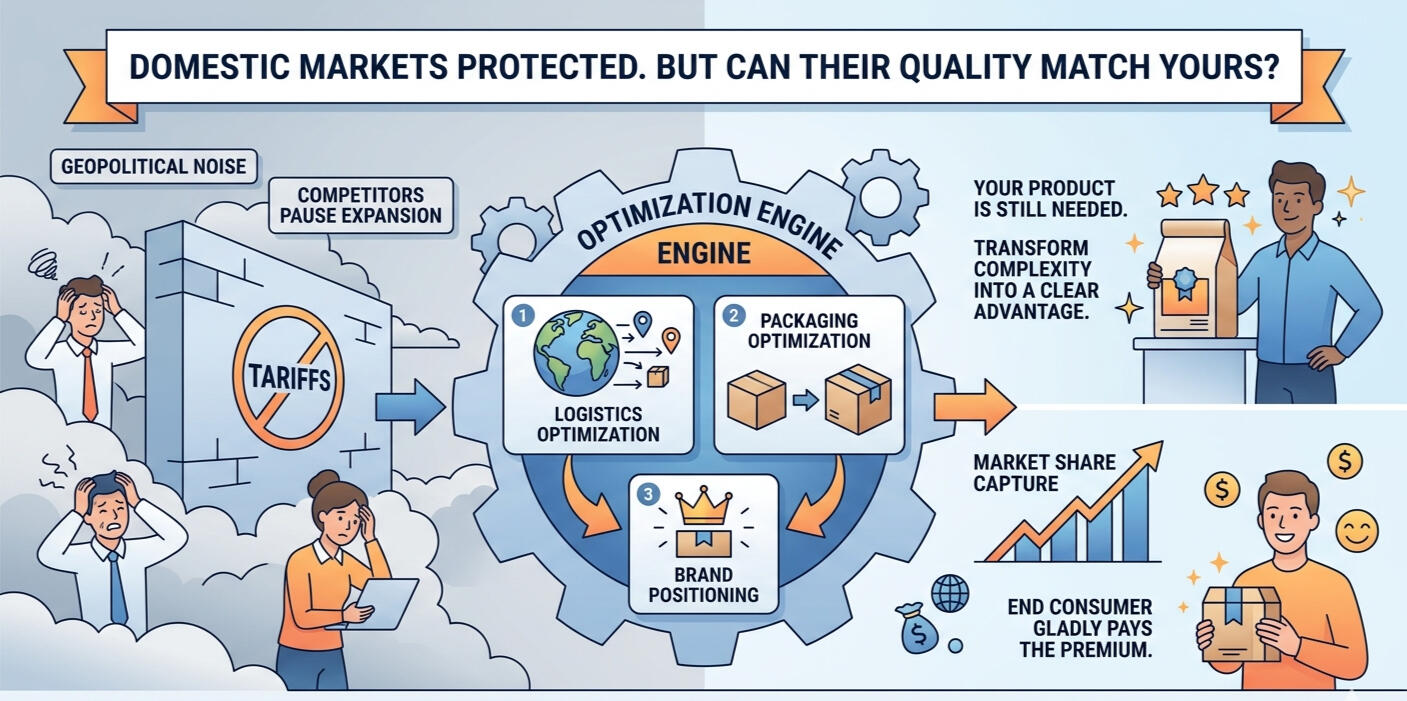
Tariffs are designed to protect the «Internal Market». However, domestic industries often cannot match the exporter quality or scale. This means the importer still needs your product, but they might attempt to re-negotiate your buying price to offset their new tax burden. This is where a strong Negotiation Strategy becomes your greatest asset.
3. Competitive Advantage
In some cases, a tariff affects your competitors more than the exporter. If the exporter has a diversified supply chain or a superior brand position, a tariff can actually be an opportunity to capture market share from «weaker» international rivals who cannot sustain the price shift.
Geopolitics will always be noisy. Tariffs will rise and fall. But shutting down your international expansion because of a misunderstanding of customs mechanics is a missed opportunity for legacy-level growth.
Democratizing internationalisation means replacing fear with facts. Tariffs are simply a mathematical variable in your pricing and distribution strategy, they are not a stop sign.
At AdD Global, we build the operational frameworks and strategies that allow you to navigate these variables with absolute clarity. You focus on manufacturing excellence; we make sure your market entry is calculated, profitable, and secure.
Pablo Gallardo
April 2026